


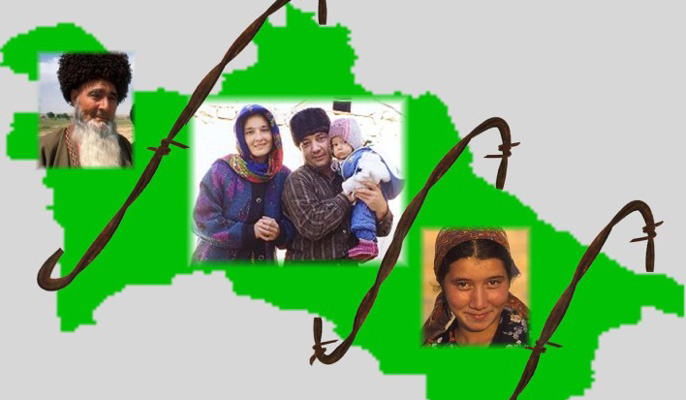


For the upcoming EU-Turkmenistan Human Rights Dialogue, scheduled for June 22 in Ashgabat, the THF has prepared a report titled "TURKMENISTAN: Increased repression and violence against dissidents. Accountability for torture, death, and lawlessness."
Serdar Gurbanguly Berdimuhamedov assumed the office of President of Turkmenistan in 2022. Although some experts claim that his father, former President Gurbanguly Berdimuhamedov, fully controls the country and that Serdar serves merely as a formal head of state, but this is not the case. Together with his father, Serdar is a key element of the authoritarian system of power built by the Berdimuhamedov family.
Following Serdar's election as president, the family once again employed the narrative of a “young reformer,” a strategy that had already been successfully used in 2007 after the death of the first president, Saparmurat Niyazov, when Gurbanguly Berdimuhamedov was elected president.
Under Serdar's leadership, the anti-democratic apparatus has been preserved and continues to function in the same manner. At the same time, in the sphere of cross-border persecution, Serdar Berdimuhamedov has surpassed the father.
The political system established in Turkmenistan entails the personal responsibility of the country's leadership, represented by Serdar Berdimuhamedov, under whose control are the security services, the judicial system, the media, and the Internet.
State terror is used in the country as a method of governance. The regime of S. Berdimuhamedov uses fear as its primary instrument for maintaining power. Any manifestation of disloyalty—from reporting meat prices on social media, not to mention making critical comments, to attempting to contact independent journalists—may result in harassment, persecution, and repression.
Key Practices:
Arbitrary detentions without proper documentation, arrests based on fabricated charges, and non-transparent judicial proceedings;
Complete subordination of courts and prosecutors to the president, effectively performing punitive functions;
Collective punishment, including pressure on relatives and family members;
Public condemnation involving community members, colleagues, and neighbors as a form of social pressure;
Arbitrary refusal to issue passports, resulting in travel bans as a form of punishment.
All these measures are implemented with the knowledge and political responsibility of the president, who is the head of state and exercises control over the security apparatus.
The government conceals cases of torture and inhuman treatment in places of detention, thereby effectively turning a blind eye to the mistreatment of citizens. Torture in detention centers and prisons in Turkmenistan is not uncommon. Its regular occurrence and the lack of accountability indicate tacit approval by the highest levels of leadership.
It should be noted that, compared even with neighboring Central Asian countries, Turkmenistan is an extremely closed country in terms of access to information regarding the observance of citizens’ rights.
The analysis presented below is the result of many years of meticulous work by dozens of concerned individuals both abroad and within the country. The report was prepared by the Turkmen Helsinki Foundation for Human Rights (THF) with the assistance of Crude Accountability and human rights defender Vitaly Ponomarev, to whom THF expresses its gratitude.
The report does not claim to be a complete and exhaustive study due to time and other limitations. The document was translated into English using artificial intelligence. The Russian version is the original document. None of the contributors to this report received financial or any other form of compensation.
The following section of the document contains information about individuals who have been subjected to repression and/or violence, accompanied by brief biographical descriptions.
Human rights defenders and independent foreign media have documented the following forms of abuse:
Physical beatings and torture;
Psychological pressure and threats of violence;
Detention in life-threatening conditions;
Denial of medical care, including as a form of punishment;
Restrictions on leaving the country for medical treatment or education.
The government's refusal to allow international observers access to places of detention is a deliberate political decision aimed at concealing the scale of violence. There is no death penalty in Turkmenistan, but deaths in places of detention involving political prisoners, dissenters, and opponents of the regime are systematically and carefully concealed. Typical features include: the absence of independent investigations; refusal to inform relatives of the real causes of death of political prisoners; release of bodies accompanied by demands for immediate burial; and intimidation of the families of deceased opponents of the regime.
This report examines the five-year practice of enforced disappearances under the leadership of Serdar Berdimuhamedov, who continues the policies of his predecessors, thereby demonstrating conscious complicity in the crimes of the regime. Some political prisoners are kept in complete isolation for years or die in custody, while the state refuses to provide information about them and maintains total control over this process.
Moreover, the president bears direct responsibility for: the complete destruction of freedom of speech; the criminalization of independent journalism; and the creation of an atmosphere of universal surveillance and self-censorship. The Internet in the country is used not as a means of communication and the exercise of the right to receive information, but as an instrument for identifying unreliable individuals: access is restricted, correspondence is monitored, and users are punished for critical content and comments.
You can read the Report in more detail by following the link.


